Google
 
Showing posts with label houseplants. Show all posts

Tuesday, December 04, 2007

For color in winter, try orchids

Though it's technically fall, winter weather has descended upon Portland. We had our first big storm over the weekend, with high winds and enough rain to cause considerable flooding. And it's been cold, dark, and dreary for several weeks. When daytime highs don't break 50, it's winter, regardless of what the calendar says. With the dark days and no more pretty fall leaves, I appreciate any spots of color I can find. Aside from the beautyberry and one camellia, there's nothing but green and brown in the yard, but my kitchen windowsill is starting to look like a tropical paradise. There's nothing like orchids to brighten up a Northwest winter.

I don't know what species this one is. I got it on sale after it had finished blooming, and the tag was missing.
P1050549

Oncidium Mtssa Royal Robe 'Jerry's Pick'
P1050550

Cymbidium, variety unknown. I forgot to bring it in from the unheated greenhouse before the cold weather started, so it developed some brown spots on the blooms. Normally it's pure yellow.
Yellow cymbidium with some ugly brown spots

I don't claim to be an expert on growing orchids, but the common ones do well for me--better than most houseplants, in fact. I have a couple oncidiums, a phalaenopsis or two, and my treasured cymbidium. All bloom at least once per year, even though I usually forget to fertilize them and sometimes forget to water them regularly. I have all but the cymbidium in an east window above my kitchen sink, so they get bright morning sun and lots of humidity from the sink and dishwasher. The cymbidium lives in front of a south window during the cold months and outside in part sun the rest of the year. I've tried orchids in my office, which gets great light, but they don't do well. I don't think there's enough humidity for them there.

The one problem with orchids? They're expensive (like that $99 cymbidium I mentioned in my last post). But there are ways to get them for less than the going rate:

  • Buy them after they've bloomed. You don't get instant gratification, but you'll pay 1/2 to 2/3 the regular price. I got my cymbidium from Home Depot for $15 when its original price was $30.
  • Try a home and garden show. I got some of my at Portland's annual Yard, Garden and Patio show from an orchid grower based in Hawaii. They were a little smaller than the ones you typically see at the florist's, and they weren't blooming. But they were about $7 -- not bad.
  • Try eBay. I just looked and found some good deals. If only I had a bigger windowsill...

So, if you have a sunny kitchen windowsill, get yourself some orchids. They'll brighten your winter days and impress your friends.

Friday, November 04, 2005

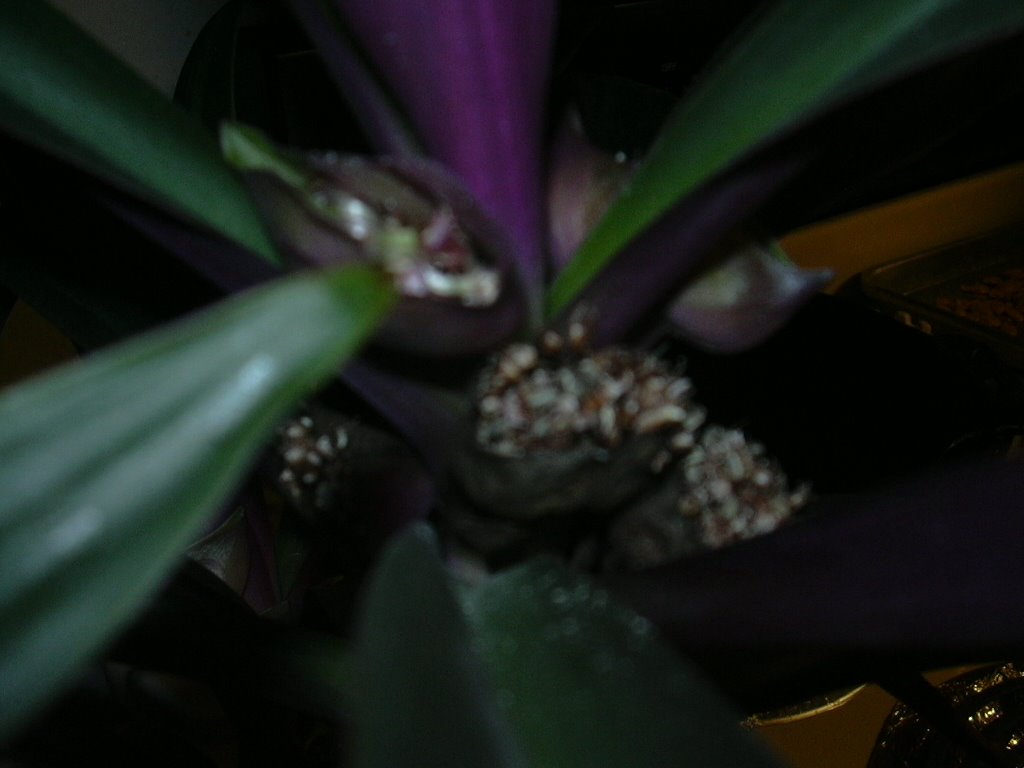
Tradescantia spathacea - a perfect houseplant for people with black thumbs


For an uncommon houseplant, T. spathacea has a lot of common names: oysterplant, boatlily, Moses-in-a-basket, Moses-in-a-boat, Moses-in-a cradle (sheesh - shouldn't Charlton Heston be around here somewhere? :-) ) I rarely see it for sale here in the Northwest, but I've seen it online occasionally.

I'm surprised it isn't sold more, because it's a great houseplant. It grows quickly with no pampering and offers both interesting flowers and beautiful leaves with rich purple undersides. It's a great houseplant for black thumbs, because it's very tolerant of abuse and benign neglect. It prefers medium to high light and moist soil, but it tolerates lower light and dryness well. It's also a great office plant. Mine thrives about 4 feet from a south-facing window here in cloudy Portland and looks none the worse for wear when I return from a week's vacation. A colleague of mine grows one with no natural light at all, only fluorescent light from ceiling fixtures about 7 feet away. It doesn't grow very fast or bloom, and it doesn't have the rich purple color under the leaves, but it looks OK and has survived these conditions for several years.

Propagation is easy. Stem cuttings root quickly in water or moist soil and soon grow into healthy-sized plants. The plants also produce lots of seeds, but I haven't tried starting any that way.

T. spathacea is hardy to zone 9. But if you live in zone 9 or above, please note that it is considered invasive in Florida and Louisiana, so you may want to keep it where it can't naturalize. For more information on T. spathacea, see http://www.floridata.com/ref/T/trad_spa.cfm.

On a personal note, I got my first T. spathacea as a stem cutting from a friend; I brought it back to Portland from Georgia in my carry-on bag. My friend died several years ago of breast cancer, making my plant is a living memento of our friendship.

--
Posted by Janet to Rainy Day Gardening - Houseplants and Tropicals at 11/03/2005 07:44:00 PM