Google
 

Tuesday, June 26, 2007

Snake in the compost bin!

So I was trying to be a Good Organic Gardener this evening, watering the compost bin so the stuff will break down properly, and I ended up giving a snake a shower! Apparently a garter snake had taken up residence in the compost bin, and it didn't seem too happy with the blast of cold water. Down to the bottom of the pile it went. Ah, well... I wish it good hunting. Lots of insects in that bin.

Sunday, June 10, 2007

Carnivorous pitcher plants on parade

In case you, dear readers, have not yet realized that I'm a little strange, this post should convince you. For the last four years or so, I've been growing carnivorous plants, mostly North American and Asian pitcher plants and a few flytraps. The flytraps didn't like our winter this year, so a lot of them didn't make it. But the pitchers are lookin' good. The Asian pitchers, (Nepenthes), grow in my kitchen window, some in hanging baskets and others on the windowsill. The North American pitchers (Sarracenia) prefer to be outside, so they grow in pots on my deck. This is the time of year when they look their best, especially the North American pitchers. They've woken up from their winter sleep, and they're flowering and producing lots of new pitchers. Here are a few pics:


Sarracenia

Sarracenia

Sarracenia purpurea in bloom

And closeups of a couple flowers:

Sarracenia purpurea flower

Bloom on carnivorous pitcher plant

The Asian pitchers don't go dormant in winter, but they do stop pitchering. Mine are just starting to produce new pitchers:

Nepenthes

Nepenthes

Nepenthes burbidgeae

The most common question I get about these strange plants is, "Do you have to feed them?" I do feed the indoor ones. Pity the hapless insect that finds its way into my house. It will be stunned with a rolled-up newspaper and popped into a Nepenthes pitcher faster than you can say, "Dinner time!" The plants that are outside catch plenty of their own food. Some of my larger pitchers will be filled to the top with insect carcasses by the end of the summer. One of the first things I learned when I started growing them was, Never look inside the pitchers! You don't want to see what goes on in there, but it would make a great arthropod horror movie.

If you're one of the few people who thinks all this is cool rather than disgusting, I recommend you get a copy of The Savage Garden, which will tell you all you need to know about growing carnivorous plants:


And if you're ready to grow some of your own, I recommend Sarracenia Northwest, an online carnivorous plant nursery based here in Oregon: http://www.cobraplant.com/cmd.php?af=382064

Saturday, May 19, 2007

It's May, and the gardening is sweet!

What a fantastic time of year to be a Northwest gardener! Plants are fairly bursting out of their beds with an exuberance matched only by the weeds, blooms are everywhere, the soil is warming up enough for warm season vegetables... and my to-do list is so long that merely reading it exhausts me. But it's my favorite time of year in the garden, and I only wish I could take the month off from work to garden full-time.

This post will provide a quick update on the garden, and that's about it. After all, it's Saturday, and there's gardening to do!

Veggies
Asparagus has been bearing for a few weeks and still going strong. Hubby didn't harvest during the week I was out of town, so there are already a couple of fronds that are about 4 feet high.

I harvested some radishes a couple weeks ago and another bunch last night. Radishes are great for people like me who like instant gratification.

Lettuce is doing well... when I can keep the slugs off it. I can start harvesting a few leaves this weekend, with more to come.


Flowers
Columbine is blooming and really jazzing up my woodland garden. Here are a few pictures:
Columbine Columbine Columbine closeup Columbine

Meadow rue -- weird-looking but pretty:
Meadow rue

Rhododendrons -- some are in full bloom, and others are just getting started:
Rhododendron Rhododendron

Miniature roses are gorgeous:
Miniature rose Miniature rose

I took the citrus trees out of the greenhouse a couple weeks ago, and most of them are blooming like crazy. My front yard smells like citrus blossoms -- heavenly!
Lemon blossoms

And finally, the carnivorous pitcher plants are coming out of their winter sleep. They have strange-but-cool-looking flowers:
Bloom on carnivorous pitcher plant Bloom on carnivorous pitcher plant

The peonies have buds on them, and my white lilac just finished blooming.

There's lots to do in the garden. Next up: Planting the warm season veggies (beans, tomatoes, cucumbers, peppers, squash, and melons). This weekend I hope to get the beds manured and ready, with actual planting planned for next weekend. Busy, busy, busy!

Friday, April 06, 2007

The perfect Father's Day gift??


When I first saw this, I thought it was an April Fools joke, but no, it's a real product. Check out the Weed Flame Torch Kit. Yes, instead of pulling or hoeing weeds, you can burn them with a 100,000 BTU torch! They also make a 500,000 BTU model for those of you with higher-than-average testosterone levels. ROTFLMAO! I've always said I thought flamethrowers would make excellent gardening implements, but I was *joking*.

Rita Rudner says men will cook if there's danger involved (hence the thriving market for gas grills). But will they garden if there's danger involved?

How about it guys? Would you use this thing?

Monday, March 26, 2007

A few random updates and observations

I always think of ideas to post here, but in order to do the thing right, I need pictures and a coherent narrative. Both of those require a bit of time and effort, though, which usually stops me cold. So tonight's post will consist of a few random things, and if there are illustrations (there probably will be), they'll be pictures I've already taken and posted to Flickr. Here we go...

It's finally spring here in Portland! Daffodils are in full bloom, my red flowering currant is gorgeous (sure wish I had a pic handy), and the flowering quinces and hellebores are on the wane. But I do have a hellebore pic from about a month ago to share:

Hellebore

Now that it's spring, I have to get serious about garden chores. Last week I spent an afternoon planting tomatoes and peppers. The challenge for me is where to put them. I have a greenhouse, but it isn't warm enough to germinate warm-season veggies this early in the year. I usually put seed flats on top of my reef tank, where the lights under the lid provide about 85 degrees of bottom heat. I get really fast germination, but then I have another problem... where to move the seedlings? There isn't enough light on top of the aquarium, so I have to find a new location. I have shop lights in my spare bedroom closet, a 20-gal aquarium with fluorescent lights in my bedroom, and a 4-shelf mini greenhouse against a south-facing wall on my deck. The mini greenhouse is perfect for cool season crops (unless we get unseasonably warm weather; then they fry), but it usually doesn't work well for warm season stuff till late April. That leaves the indoor options, in which I can house about 5 flats. That's never enough space.

In the meantime, I decided to clean the dead stuff out of my big greenhouse, so I could eventually move seedlings there. Last fall I had the brilliant idea to dig up my pepper plants and put them in the greenhouse. Peppers are tropical shrubs, so I hoped they'd winter over. They didn't. The bouganvilla and mandevilla bit the dust too during our 20-degree cold spell. Even with 2 heaters running, I couldn't keep the greenhouse above freezing. *Sigh* But now that all the plant corpses have been composted, I have a bit more room. I'm sure I'll fill the space with something, probably very soon. The First Law of Greenhouses is that plant collections expand to fill all available space.
Publish
That's a sufficient update for now. Hopefully it won't take me 2 months to post again. And heck, maybe I'll even have pictures next time.

Tuesday, January 16, 2007

Let it snow!

I don't have anything of great substance to say today, but I'd like to share some pics from our first real snow day of the winter. People who live in cold, snowy places probably get tired of seeing their gardens shrouded in white, but it's a lovely novelty here in Portland.

Here's the front of my house:
P1010177

The creek in our backyard, a/k/a our naturescaping project:
P1010182

Our neighbor's blue spruce -- too bad Christmas is over
P1010187

Interesting texture:
P1010194

Snowy sword fern, a common site when it snows in Western Oregon:
P1010195

And finally, the purple pitcher plant on my back deck (Sarracenia purpurea). Sorry dude... no bugs for you today!
P1010208

Monday, December 11, 2006

Now this might convince you to give up pesticides!

A post on Garden Rant talks about a recent study linking pesticide use to smaller penises and low testosterone levels in male alligators and abnormal ovaries in female alligators. A comment on the post links to a study from the U of Missouri suggesting that sperm problems in human males could be related to agricultural chemicals. Here's a summary of the findings:
Semen quality was equally high in Minneapolis and New York, and slightly lower in Los Angeles. However, men in mid-Missouri had counts and quality that were significantly lower than men from any of the urban centers.
Scary stuff.

My garden has been pesticide-free for several years now, except for slug bait (and I use mostly iron phosphate now), and I haven't had any insect problems that a good dose of Safter soap couldn't fix. No, my plants don't look perfect, but they grow well.

God's take on lawns

Two posts in 10 minutes? A new record! But I just found a great piece on GardenWeb which is worth reposting here. Think about this when it's time to whip out the lawn mower next spring:

GOD'S TAKE ON LAWNS:
Imagine the conversation The Creator might have had with St. Francis on the subject of lawns:

God: Hey St. Francis, you know all about gardens and nature. What in the world is going on down there in the Midwest? What happened to the dandelions, violets, thistle and stuff I started eons ago? I had a perfect "no maintenance" garden plan. Those plants grow in any type of soil, withstand drought and multiply with abandon. The nectar from the long lasting blossoms attracts butterflies, honey bees and flocks of songbirds. I expected to see a vast garden of colors by now. But all I see are these green rectangles.

St. Francis: It's the tribes that settled there, Lord. The Suburbanites. They started calling your flowers "weeds" and went to great lengths to kill them and replace them with grass.

God: Grass? But it's so boring. It's not colorful. It doesn't attract butterflies, birds and bees, only grubs and sod worms. It's temperamental with temperatures. Do these Suburbanites really want all that grass growing there?

St. Francis: Apparently so, Lord. They go to great pains to grow it and keep it green. The begin each spring by fertilizing grass and poisoning any other plant that crops up in the lawn.

God: The spring rains and warm weather probably make grass grow really fast. That must make the Suburbanites happy.

St. Francis: Apparently not, Lord. As soon as it grows a little, they cut it... sometimes twice a week.

God: They cut it? Do they then bail it like hay?

St. Francis: Not exactly, Lord. Most of them rake it up and put it in bags.

God: They bag it? Why? Is it a cash crop? Do they sell it?

St. Francis: No Sir. Just the opposite. They pay to throw it away.

God: Now let me get this straight. They fertilize grass so when it does grow, they cut it off and pay to throw it away?

St. Francis: Yes, Sir.

God: These Suburbanites must be relieved in the summer when we cut back on the rain and turn up the heat. That surely slows the growth and saves them a lot of work.

St. Francis: You are not going to believe this Lord. When the grass stops growing so fast, they drag out hoses and pay more money to water it so they can continue to mow it and pay to get rid of it.

God: What nonsense. At least they kept some of the trees. That was a sheer stroke of genius, if I do say so myself. The trees grow leaves in the spring to provide beauty and shade in the summer. In the autumn they fall to the ground and form a natural blanket to keep moisture in the soil and protect the trees and bushes. Plus, as they rot, the leaves form compost to enhance the soil. It's a natural circle of life.

St. Francis: You better sit down, Lord. The Suburbanites have drawn a new circle. As soon as the leaves fall, they rake them into great piles and pay to have them hauled away.

God: No. What do they do to protect the shrub and tree roots in the winter and to keep the soil moist and loose?

St. Francis: After throwing away the leaves, they go out and buy something which they call mulch. The haul it home and spread it around in place of the leaves.

God: And where do they get this mulch?

St. Francis: They cut down trees and grind them up to make the mulch.

God: Enough. I don't want to think about this anymore. Sister Catherine, you're in charge of the arts. What movie have you scheduled for us tonight?

Sister Catherine: "Dumb and Dumber", Lord. It's a real stupid movie about.....

God: Never mind, I think I just heard the whole story from St. Francis.

Armchair tomato gardening

OK tomato gardeners, it may be cold and grey outside, but we can still indulge our passion for love apples. Ronni Lundy's In Praise of Tomatoes: Tasty Recipes, Garden Secrets, Legends & Lore offers an excellent opportunity to daydream about last year's tomato patch while learning something that may help us with next year's crop. If you're looking for a guide to growing tomatoes, look elsewhere. But if you'd like to learn about the history of this popular garden vegetable, get some new--and creative--recipes, and admire some gorgeous full-color illustrations, this is the book for you. It includes a useful chart of tomato varieties that gardeners will find helpful, but otherwise the emphasis here is not how to grow tomatoes, but why to grow them. After drooling over recipes for green tomato ketchup, red tomato and lemon jam, and spicy red tomato cake, I'm ready to start planning for next year's crop.

Sunday, December 10, 2006

How to Root Softwood Cuttings - Plant Propagation Forum - GardenWeb

I just stumbled across a great posting on GardenWeb that explains how to root softwood cuttings. It includes very basic instructions and pictures -- perfect for beginners. Take a look: Easy - How to Root Softwood Cuttings - Plant Propagation Forum - GardenWeb

Sunday, November 19, 2006

10 Easy Soil Tests

Another gem from Organic Gardening - 10 Easy Soil Tests. These sound like a great way to better know your soil.

Another tip for lazy gardeners, courtesy of Organic Gardening

Interesting coincidence. Yesterday I explained my lazy composting/mulching method. This morning my e-mail newsletter from Organic Gardening includes a link to their Simple Composting Method.

So, if you're lazy like me, now you have another option.

Saturday, November 18, 2006

Cheap, lazy gardening tip: mulch with free stuff that's easy to get

I just spent a couple of hours mulching my front yard with stuff that cost me nothing but a bit of effort. This morning our church had its annual leaf-raking party. Hubby and I hauled away all the leaves and pine needles, saving the church the hassle of getting rid of them and furnishing us with lots of great mulch. We had also been stockpiling newspapers for a few months, so we had everything we needed to enrich the soil and assure a mostly-weed-free yard in the spring. I cleared away any noxious, invasive weeds (bindweed, crabgrass, etc.) and laid down thick pads of newspaper (at least 8 layers thick; preferably thicker). Then I poured leaves on top. No need to shred the leaves first. Whole leaves will break down slowly all winter, feeding the soil and providing a thick weed barrier.

Because pine needles are acidic, I use them only around acid-loving plants like rhododendrons or blueberries, or I use them to mulch pathways, areas under big trees, or other places where I don't plan to plant anything for awhile. A layer of newspaper under pine needles really isn't necessary unless you have a major weed problem. And you don't want to put newspaper under pine needles when making a path, because the pine needles slide across the paper, making for a slippery, dangerous path.

If you have a large area to mulch, cardboard sheets are quicker to apply than newspaper.

I like to call this method cheap, lazy gardening. You make compost in place rather than hauling everything to your compost heap, then hauling the finished compost back to where you need it. You don't have to weed (much) come spring, and you don't have to dig (much) at planting time. When I use this method, I never till--ever. I just rake back the mulch, plant, and scoot the mulch back around the plants. Or, for veggies and other heavy feeders, I rake the mulch into my pathways, plant my row, and mulch with manure and/or compost. The remaining leaves help keep the path dry and weed-free. And everything you use is free.

If you don't have a ready supply of leaves like I do, consider picking up bagged leaves from the curb in front of your neighbors' houses. They won't care, and you'll get lots of free mulch. You could even be a good Samaritan and offer to rake leaves for elderly neighbors in return for the leaves.

Let's hear it for cheap and lazy!

Saturday, October 21, 2006

Moving plants into the greenhouse for winter

I haven't posted about my greenhouse adventures in ages. I got my first (and only) greenhouse a year ago June. Last year I wintered over a bunch of tender perennials sold as annuals, with mixed success. Petunias did very well, but a lot of the other stuff died (partly my fault for going too long between waterings and having inadequate air circulation in the greenhouse).

Fast forward to this year. I spent most of today moving stuff into the greenhouse, since our nights here in Portland are beginning to get cold. We've had frost in some areas already, though what we got at my place was more like slush and didn't kill anything off. But why tempt fate? So I got busy.

In addition to the citrus and brugmansia from last year, I have some bouganvilla and mandevilla. Plus, this year I'm trying an experiment. I dug up my bell peppers and jalapenos, potted 'em up, and moved them into the greenhouse. I don't expect them to bear during the winter, since I don't provide supplemental light, and I only keep the greenhouse heated enough to keep things from freezing. But I'm hoping to keep them alive so they can get an earlier start next spring. Plus I think it'll be cool to have shrub-sized pepper plants.

Monday, October 16, 2006

Grow a giant pumpkin next year!

This year I grew Atlantic Giant pumpkins for the first time. While large, mine were nowhere near world record holders, mostly because I didn't give them the daily TLC required to produce orange behemoths. If you do have the time and inclination to grow a pumpkin suitable for Cinderella's coach, you might want to check out the tips from Organic Gardening and start planning for next season. Good luck!

Sunday, October 15, 2006

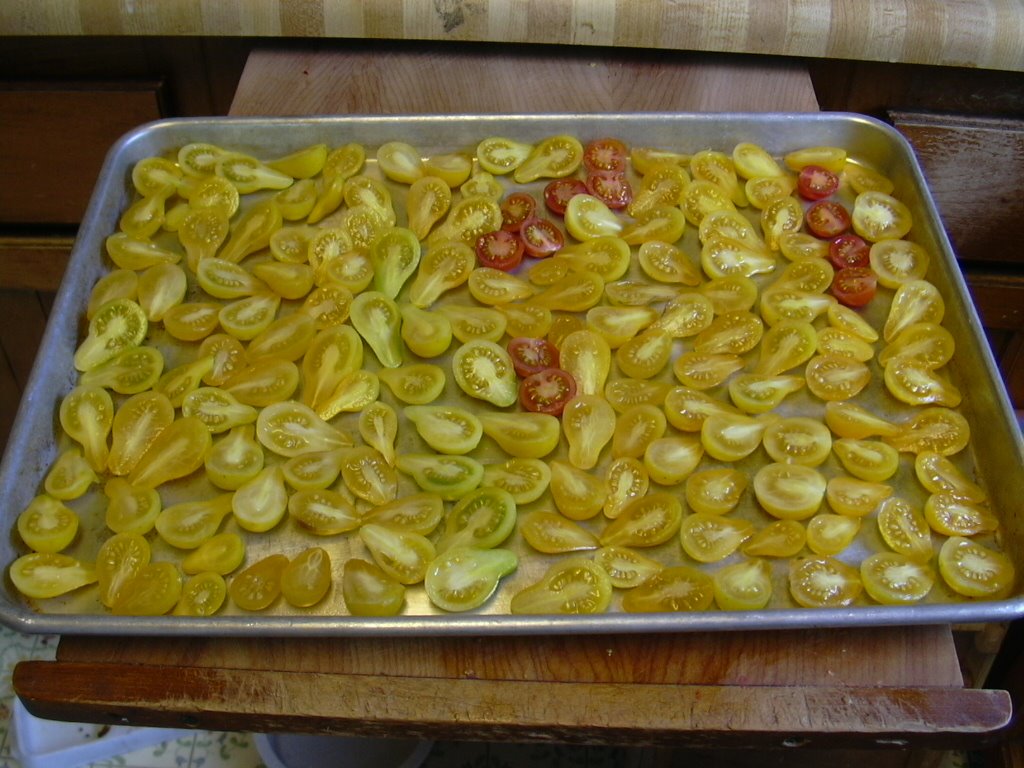
Homemade sun-dried tomatoes: the perfect use for end-of-season tomatoes


Here in Portland, tomato season is winding down. I'm still getting a few slicers, but they often get mushy or icky before they fully ripen. So I pick them when they're pink and let them ripen on my counter. My cherry tomatoes are still ripening on the vine, but they often split before I get around to harvesting them. I think it's due to the wet, dewy mornings and occasional rain showers. Soon we'll have our first frost, and I'll need to pick all the decently-developed green tomatoes to ripen in the house. So, whether they're slicers or cherry tomatoes, what I'm harvesting now isn't of high enough quality for eating out of hand. But I hate to waste them. What to do?

The most common answer is, make sauce! Yep, that works, but one can only use so much tomato sauce. And sauce isn't a practical option for cherry tomatoes, because it's way too much work to peel them. This year I tried something different -- drying them. The Cooking Inn has some good instructions, but I found a few problems with them. Their instructions for preparing cherry tomatoes are fine. But when I used their cooking temperatures, the tomatoes burned very quickly. I had better luck using lower temperatures for a longer period. Here's how I dried a boatload of cherry tomatoes, most of which were split but otherwise in good shape:

Homemade Sun-Dried Cherry Tomatoes
(Well, they're really oven-dried. What did you expect from an Oregonian?)
  1. Preheat oven to about 200-250 degrees
  2. Spray a baking sheet with non-stick spray or lightly grease with oil.
  3. Rinse cherry tomatoes and cut in half. Split ones are OK as long as they aren't discolored or starting to rot.
  4. Place tomatoes cut side up on baking sheet.
  5. Put tomatoes in oven and turn temperature down below 200. I recommend experimenting to get the right temperature. I had the best luck with my electric oven set a little below 200 with the door slightly ajar.
  6. Bake till dry but still pliable. I did mine till they were no longer sticky to the touch. You don't want to get them crunchy, because they'll be harder to use in recipes, especially pesto or something similar that has to be processed in a blender.
  7. Store them in jars with lids. You can pack them in oil (instructions available at the link mentioned above) or just store them dry.
Enjoy!

Monday, September 18, 2006

Harvest time!

Here in my Portland, OR, garden, the harvest is in full swing. I can barely keep up with the tomatoes and peppers! So far I've canned 14 quarts of tomatoes, frozen about 8 quarts of spaghetti sauce, and made about 3 quarts of pizza sauce -- and I have another load of tomatoes to pick today. All this came from just 12 plants too.

To help with the harvest, Organic Gardening posted a great article with tips on when and how to harvest various crops. It includes information on how to tell when a vegetable is ripe and how to harvest and store it to ensure the best flavor.

As time permits, I hope to post some recipes and other tips from my own harvest. But for now, it's back to the kitchen.

Wednesday, July 12, 2006

ScienceDaily: Scientists Confirm Folk Remedy Repels Mosquitoes

No, I'm not dead. I've just been busy with other things, and I've developed quite a backlog of stuff to post about. In the meantime, though, ScienceDaily has a fascinating article on using beautyberry for repelling mosquitoes: ScienceDaily: Scientists Confirm Folk Remedy Repels Mosquitoes. The article notes that this folk remedy was recently studied: "Three repellent chemicals were extracted during the 12-month study: callicarpenal, intermedeol and spathulenol. The research concluded that all three chemicals repulse mosquitoes known to transmit yellow fever and malaria. "

Saturday, March 04, 2006

A Celebration of Heirloom Vegetables


I just finished a great book on growing and cooking with heirloom vegetables. A Celebration of Heirloom Vegetables: Growing and Cooking Old-Time Varieties (by Roger Yepsen) covers 25 types of heirloom veggies, from the familiar squash, beans, and melons to kohlrabi, rutabaga, and tomatillos. Each chapter includes varieties, brief growing and harvesting instructions, instructions for saving seeds, and beautiful full-color botanical drawings. The chapters end with recipes, from simple to complex, some with an international flavor. Kitchen gardeners will love this book.